The 2006 annual letter from Berkshire Hathaway Chairman Warren E. Buffett makes an interesting read (Tell me something new!!!)
I was attracted to where he explains about the Equitas deal where Berkshire re-insures Equitas against upto $13.9 billion claims for securities and cash of $7.12 billion. Assuming the 10.4% return of S&P 500 as laid out in the letter, they will break-even in 6-7 years and changing the return to 21.6%, the break-even would be in 3-4 years. In Buffett's estimate, the payout period for the $13.9 billion is as long as 50 years. Just one word to describe the deal - ingenious!!!!!!!!!!!

Custom Search
Friday, March 02, 2007


Wednesday, February 28, 2007
India Budget 2007-08 and 2006-07 report card
Indian Budget was presented today. A few quick observations:-
On Economy:-
* A 9.2% growth in GDP with services and manufacturing growth at more than 11%
* Real Growth (i.e.inflation adjusted) per capita income is 7.4%
* A high level of savings rate at more than 30%
* Fiscal Deficit at 3.7% for 2006-07 and budgeted at 3.3% for 2007-08
Areas of concern:-
* Money Supply (M3) grew by 21.3%. High inflation risk.
Structural Initiatives/Changes:-
* Social Security Net to be expanded to cover the heads of 80 lakhs (8 million) rural landless households not covered presently. Government proposes to pay the 50% of premium of Rs 200 (approx USD 5) per year.
* Government plans to acquire RBI's 60% stake in State Bank of India. Why?
* Proposes to use a small part of the foreign exchange reserves without the risk of monetary expansion for financing infrastructure. RBI will be assured of a return higher than the average rate of return on its incremental investment.
* Proposal to set up an autonomous Debt Management Office and as a first phase a middle office, in a move towards better fiscal discipline.
Mortgages
* Announces creation of "Reverse Mortgage" through National Housing Bank.
* Creation of Mortgage Guarantee Companies I assume, along the lines of Freddie and Fannie.
Taxation:-
* Asset Management Services provided by individuals will be levied service tax.
* Small and Medium Enterprises (with less than 1 crore (10 million) in taxable income) will have a reduced rate of income tax.
* Proposal to grant pass-through status to venture capital funds in respect of investments in venture capital undertakings in biotechnology; information technology relating to hardware and software development; nanotechnology; seed research and development; research and development of new chemical entities in the pharmaceutical sector; dairy industry; poultry industry; and production of bio-fuels and for investment in hotel-cum-convention centres of a certain description and size.
* Definition of capital gains to extend to include certain works of art
* Proposal to raise the rate of dividend distribution tax from 12.5 per cent to 15 per cent on dividends distributed by companies
* Proposal to raise the dividend distribution tax on dividends paid by money market mutual funds and liquid mutual funds to 25 per cent for all investors.
* Proposal to bring ESOPs under Fringe Benefit Tax
On Economy:-
* A 9.2% growth in GDP with services and manufacturing growth at more than 11%
* Real Growth (i.e.inflation adjusted) per capita income is 7.4%
* A high level of savings rate at more than 30%
* Fiscal Deficit at 3.7% for 2006-07 and budgeted at 3.3% for 2007-08
Areas of concern:-
* Money Supply (M3) grew by 21.3%. High inflation risk.
Structural Initiatives/Changes:-
* Social Security Net to be expanded to cover the heads of 80 lakhs (8 million) rural landless households not covered presently. Government proposes to pay the 50% of premium of Rs 200 (approx USD 5) per year.
* Government plans to acquire RBI's 60% stake in State Bank of India. Why?
* Proposes to use a small part of the foreign exchange reserves without the risk of monetary expansion for financing infrastructure. RBI will be assured of a return higher than the average rate of return on its incremental investment.
* Proposal to set up an autonomous Debt Management Office and as a first phase a middle office, in a move towards better fiscal discipline.
Mortgages
* Announces creation of "Reverse Mortgage" through National Housing Bank.
* Creation of Mortgage Guarantee Companies I assume, along the lines of Freddie and Fannie.
Taxation:-
* Asset Management Services provided by individuals will be levied service tax.
* Small and Medium Enterprises (with less than 1 crore (10 million) in taxable income) will have a reduced rate of income tax.
* Proposal to grant pass-through status to venture capital funds in respect of investments in venture capital undertakings in biotechnology; information technology relating to hardware and software development; nanotechnology; seed research and development; research and development of new chemical entities in the pharmaceutical sector; dairy industry; poultry industry; and production of bio-fuels and for investment in hotel-cum-convention centres of a certain description and size.
* Definition of capital gains to extend to include certain works of art
* Proposal to raise the rate of dividend distribution tax from 12.5 per cent to 15 per cent on dividends distributed by companies
* Proposal to raise the dividend distribution tax on dividends paid by money market mutual funds and liquid mutual funds to 25 per cent for all investors.
* Proposal to bring ESOPs under Fringe Benefit Tax
Wednesday, February 21, 2007
Influence: Psychology of Persuasion
I just finished reading Influence: Psychology of Persuasion by Robert B. Cialdini, Ph.D. Charlie Munger of Berkshire Hathaway recommends it in his Almanack.
Robert Cialdini discusses the six categories of "weapons of influence" used by "compliance" professionals. To list them:-
1. Reciprocation: The Old Give and Take.....and Take
2. Commitment and Consistency: Hobgoblins of the Mind
3. Social Proof: Truths are us
4. Liking: The Friendly Thief
5. Authority: Directed Defense
6. Scarcity: The Rule of the Few
The basic premise of the book is that there are "hot-buttons" that can be and are used to extract automatic responses from human beings. We have developed, consciously or unconsciously, short-cuts for dealing with everyday challenges or "click" and "whirr" actions. In the words of the author:
"You and I exist in an extraordinarily complicated stimulus environment, ...... To deal with it, we need shortcuts. We can't be expected to recognize and analyze all the aspects in each person, event and situation we encounter in even one day....we must very often use our stereotypes, our rules of thumb to classify things according to a few key features and then to respond mindlessly when one or another of these trigger features is present."
"....Sometimes the behavior that unrolls will not be appropriate for the situation, because not even the best stereotypes and trigger features work every time. But we accept their imperfection, since there is really no other choice. Without them we would stand frozen-cataloging, appraising, and calibrating- as the time for action sped by and away."
What is surprising is the nearly mechanical process in which all the six weapons can be activated, and the consequent exploitability of this power by anyone who knows how to trigger them. The author compares it to Jujitsu where the practitioner exploits gravity, leverage, momentum and inertia. Paramount to all of this is the ability to manipulate without the appearance of manipulation.
One of the techniques used commonly for all the weapons is the contrast principle. I have experienced it first hand while I was trying to buy my first house in the United States. My realtor took me through some of the not so well-kept houses that were priced within my low range and then took me to the one that was at the high range which would earn him higher commission. The order in which it was presented was interesting. I was tempted; however, unwittingly, I ended up using the defense that the author prescribes - gave my realtor an excuse about how I had no immediate access to the extra funds that would be required for down payment to that particular piece of property.
How does this apply to the business at hand - of buying securities? Have you had to compare a stock that is now cheaper from what it was a month ago? Or have you had to compare two stocks that are priced differently despite different EPS?
Let me discuss one of the techniques here
Reciprocation - Watch the technique used by Amway Distributors and any other process that starts with uninvited gifts. It can work in two ways - an obligation to repay favors we have received or an obligation to make a concession to someone who has made a concession to us. In the second case, the compliance practitioner starts with a bigger request and after a few "No"s ratchets it down to smaller ones. The author calls it the 'rejection-then-retreat' technique.
The good thing about the book is that it is replete with anecdotes and detailed instances of the weapons in practice. The other is having outlined the use of the weapons, the author goes on to talk about how to defuse its effects. This is where the academic nature of the book ends and practicality begins, in my opinion. Let me end the review with author's motivation for writing the book. In his own words from the epilogue to the book:-
"..When making a decision, we will less frequently enjoy the luxury of a fully considered analysis of the total situation but will revert increaingly to a focus on a single, usually reliable feature of it.
When those single features are truly reliable, there is nothing inherently wrong with the shortcut approach of narrowed attention and automatic response to a particular piece of information. The problem comes when something causes the normally trustworthy cues to counsel us poorly, to lead us to erroneous actions and wrongheaded decisions...one such cause is the trickery of certain compliance practitioners who seek to profit from the rather mindless and mechanical nature of shortcut response..
...more than evasive action, I would urge forceful counterassault. There is an important qualification, however. Compliance professionals who play fairly by the rulse of shortcut response are not to be considered the enemy; on the contrary, they are our allies in an efficient and adaptive process of exchange. The proper targets for counteraggression are only those individuals who falsify, counterfeit, or misrepresent the evidence that naturally cues our shortcut responses.....
In short, we should be willing to use boycott, threat, confrontation, censure, tirade, nearly anything to retaliate.....
It is important to recognize, however, that thier motive for profit is not the cause fo hostilities....the real treachery, and the thing we cannot tolerate, is any attempt to make their profit in a way that threatens the reliability of our shortcuts."
Robert Cialdini discusses the six categories of "weapons of influence" used by "compliance" professionals. To list them:-
1. Reciprocation: The Old Give and Take.....and Take
2. Commitment and Consistency: Hobgoblins of the Mind
3. Social Proof: Truths are us
4. Liking: The Friendly Thief
5. Authority: Directed Defense
6. Scarcity: The Rule of the Few
The basic premise of the book is that there are "hot-buttons" that can be and are used to extract automatic responses from human beings. We have developed, consciously or unconsciously, short-cuts for dealing with everyday challenges or "click" and "whirr" actions. In the words of the author:
"You and I exist in an extraordinarily complicated stimulus environment, ...... To deal with it, we need shortcuts. We can't be expected to recognize and analyze all the aspects in each person, event and situation we encounter in even one day....we must very often use our stereotypes, our rules of thumb to classify things according to a few key features and then to respond mindlessly when one or another of these trigger features is present."
"....Sometimes the behavior that unrolls will not be appropriate for the situation, because not even the best stereotypes and trigger features work every time. But we accept their imperfection, since there is really no other choice. Without them we would stand frozen-cataloging, appraising, and calibrating- as the time for action sped by and away."
What is surprising is the nearly mechanical process in which all the six weapons can be activated, and the consequent exploitability of this power by anyone who knows how to trigger them. The author compares it to Jujitsu where the practitioner exploits gravity, leverage, momentum and inertia. Paramount to all of this is the ability to manipulate without the appearance of manipulation.
One of the techniques used commonly for all the weapons is the contrast principle. I have experienced it first hand while I was trying to buy my first house in the United States. My realtor took me through some of the not so well-kept houses that were priced within my low range and then took me to the one that was at the high range which would earn him higher commission. The order in which it was presented was interesting. I was tempted; however, unwittingly, I ended up using the defense that the author prescribes - gave my realtor an excuse about how I had no immediate access to the extra funds that would be required for down payment to that particular piece of property.
How does this apply to the business at hand - of buying securities? Have you had to compare a stock that is now cheaper from what it was a month ago? Or have you had to compare two stocks that are priced differently despite different EPS?
Let me discuss one of the techniques here
Reciprocation - Watch the technique used by Amway Distributors and any other process that starts with uninvited gifts. It can work in two ways - an obligation to repay favors we have received or an obligation to make a concession to someone who has made a concession to us. In the second case, the compliance practitioner starts with a bigger request and after a few "No"s ratchets it down to smaller ones. The author calls it the 'rejection-then-retreat' technique.
The good thing about the book is that it is replete with anecdotes and detailed instances of the weapons in practice. The other is having outlined the use of the weapons, the author goes on to talk about how to defuse its effects. This is where the academic nature of the book ends and practicality begins, in my opinion. Let me end the review with author's motivation for writing the book. In his own words from the epilogue to the book:-
"..When making a decision, we will less frequently enjoy the luxury of a fully considered analysis of the total situation but will revert increaingly to a focus on a single, usually reliable feature of it.
When those single features are truly reliable, there is nothing inherently wrong with the shortcut approach of narrowed attention and automatic response to a particular piece of information. The problem comes when something causes the normally trustworthy cues to counsel us poorly, to lead us to erroneous actions and wrongheaded decisions...one such cause is the trickery of certain compliance practitioners who seek to profit from the rather mindless and mechanical nature of shortcut response..
...more than evasive action, I would urge forceful counterassault. There is an important qualification, however. Compliance professionals who play fairly by the rulse of shortcut response are not to be considered the enemy; on the contrary, they are our allies in an efficient and adaptive process of exchange. The proper targets for counteraggression are only those individuals who falsify, counterfeit, or misrepresent the evidence that naturally cues our shortcut responses.....
In short, we should be willing to use boycott, threat, confrontation, censure, tirade, nearly anything to retaliate.....
It is important to recognize, however, that thier motive for profit is not the cause fo hostilities....the real treachery, and the thing we cannot tolerate, is any attempt to make their profit in a way that threatens the reliability of our shortcuts."
Wednesday, January 10, 2007
Emerging Market Century
I had a chance to attend a Lunch meeting by CFA Society of Washington DC. The title of the topic had caught my attention - The Emerging Market Century. The speaker was Antoine van Agtmael. It was also an introduction to his book to be published in Jan 07. What I didn't know was that Mr.Agtmael had coined the term Emerging Markets to describe the Third World. It was an interesting talk. He took World is Flat to the next level. The talk also touched upon the resource crunch we are going to face not only in oil but also water and other natural resources.
I pre-ordered the book in Amazon and received it today. I am eagerly looking forward to reading it soon.
I pre-ordered the book in Amazon and received it today. I am eagerly looking forward to reading it soon.
Saturday, December 23, 2006
How much should you pay?
Here is part of a write-up I gave my management explaining the use of P/E based valuation of ABC Company we were looking to acquire.
A Note on the profit based valuation process of ABC
"The basic objective of the valuation was to determine what we can pay for a company that can generate about 25% return on equity.
In trying to determine a multiple of profits we can pay for such a company, we would need to find out the organic (meaning, without additional infusion of capital) growth potential that it has. The metric to determine this growth is a function of current ROE and percentage of the retained current earnings. To explain this concept, intuitively, a company with a zero ROE would have no growth since it is not generating any capital for redeployment in the business and would work with same capital as it had in the beginning of a given period. Either the ROE has to turn positive or there has to be additional capital infusion for it to have any growth. For a company generating positive return on capital, the organic growth would, hence be a product of the capital it retains and the ROE. This is the first of the bases of valuation.
Arguably, either of these variables can change – ROE due to change in product profitability or similar and capital due to additional infusion/withdrawal. However, this is a decision down the line that we (as a controlling stakeholder) will make and hence, should not pay the current owners of ABC for. Hence, this metric of organic growth has no subjectivity involved."
Continuing on the above part of my note:-
ROE is the net profit available to shareholders divided by Shareholder's Equity (Book Value). This can be easily found by dividing EPS by Book Value Per Share.
A Note on the profit based valuation process of ABC
"The basic objective of the valuation was to determine what we can pay for a company that can generate about 25% return on equity.
In trying to determine a multiple of profits we can pay for such a company, we would need to find out the organic (meaning, without additional infusion of capital) growth potential that it has. The metric to determine this growth is a function of current ROE and percentage of the retained current earnings. To explain this concept, intuitively, a company with a zero ROE would have no growth since it is not generating any capital for redeployment in the business and would work with same capital as it had in the beginning of a given period. Either the ROE has to turn positive or there has to be additional capital infusion for it to have any growth. For a company generating positive return on capital, the organic growth would, hence be a product of the capital it retains and the ROE. This is the first of the bases of valuation.
Arguably, either of these variables can change – ROE due to change in product profitability or similar and capital due to additional infusion/withdrawal. However, this is a decision down the line that we (as a controlling stakeholder) will make and hence, should not pay the current owners of ABC for. Hence, this metric of organic growth has no subjectivity involved."
Continuing on the above part of my note:-
ROE is the net profit available to shareholders divided by Shareholder's Equity (Book Value). This can be easily found by dividing EPS by Book Value Per Share.
Friday, November 17, 2006
Divergent Paths - 3
Glaxo Smithkline Beecham
Coincidentally, I started buying Glaxo also on the same day. Glaxo was also a de-regulation play, in a sense. Most of the medical drugs in India at the time were under the Drug Price Control Order (DPCO), whereby the government controlled the prices at which drug companies could sell their products to consumers. As a result, the profits were depressed artificially. I looked at Glaxo and there was not much in the form of book value for my downside protection. It was around 66 and the share was trading around 400 at the time. The book value did not include the value of drug patents available in the quiver of its parent, which held controlling interest in the Indian company. The company had grown its book value @ 6% per year for the last 8 years and had an ROE of 13% pre-merger.
Glaxo came to my attention for one reason. I used to buy diabetes medicine for my grandmother on a regular basis. She swore by a pill called Diaonil prescribed to her by her doctor. If this was the case for a 70-odd year old lady with only basic education, I wondered about the rest. I found out that Glaxo marketed this drug. Later, talking to a friend who was a medical representative, I got a good understanding of the business model of the drug companies operating in India.
There were some other metrics that pointed to the direction the company was taking. There was also the proposed merger with Smith-Kline Beecham during the year. And a quick growth was in sight. I admit, there was nothing much in the balance sheet pointing towards a great share. Despite that I ended up buying it at an average cost of around 318 till Jan 03. By the end of 2003, I had a two-bagger in my hand and by March 06, it was at 1450. I had sold part of my holdings by the end of 2004 to retrieve capital. Looking at values till March 06, I had an IRR of 43.74% and an NPV of 23,143 on an investment much less than that.
Coincidentally, I started buying Glaxo also on the same day. Glaxo was also a de-regulation play, in a sense. Most of the medical drugs in India at the time were under the Drug Price Control Order (DPCO), whereby the government controlled the prices at which drug companies could sell their products to consumers. As a result, the profits were depressed artificially. I looked at Glaxo and there was not much in the form of book value for my downside protection. It was around 66 and the share was trading around 400 at the time. The book value did not include the value of drug patents available in the quiver of its parent, which held controlling interest in the Indian company. The company had grown its book value @ 6% per year for the last 8 years and had an ROE of 13% pre-merger.
Glaxo came to my attention for one reason. I used to buy diabetes medicine for my grandmother on a regular basis. She swore by a pill called Diaonil prescribed to her by her doctor. If this was the case for a 70-odd year old lady with only basic education, I wondered about the rest. I found out that Glaxo marketed this drug. Later, talking to a friend who was a medical representative, I got a good understanding of the business model of the drug companies operating in India.
There were some other metrics that pointed to the direction the company was taking. There was also the proposed merger with Smith-Kline Beecham during the year. And a quick growth was in sight. I admit, there was nothing much in the balance sheet pointing towards a great share. Despite that I ended up buying it at an average cost of around 318 till Jan 03. By the end of 2003, I had a two-bagger in my hand and by March 06, it was at 1450. I had sold part of my holdings by the end of 2004 to retrieve capital. Looking at values till March 06, I had an IRR of 43.74% and an NPV of 23,143 on an investment much less than that.
Divergent Paths - 2
Bharat Petroleum Corporation Ltd
BPCL was a de-regulation play. The government had dismantled the APM mechanism through which subsidies were distributed to oil companies to keep the petroleum product prices down. I had friends who audited one of the local refineries and had heard war stories about the mechanism. Now, the companies were free to set their own prices; or so, it seemed.
Based on the 2000 financials, the book value of BPCL was at Rs.232.98 per share. However, that was of not much use to me since they had done a 1:1 bonus issue (stock dividend) during the year. By a reasonable estimate, the book value would have been around 130 considering the growth during the year. However, the enterprise value (EV) of the company seemed to be around 250 per share, which was what I was hoping, would come to my rescue. The relevance of EV is that BPCL would not have had to face competition from other MNC oil companies when they entered, since it would have been easier for them to buy BPCL at 233 or less per share and use the control to capture the Indian market. If they decided to build a new refinery and establish the same infrastructure that BPCL already had, it would take time as well as more money to compete. Inflation was working for me for a change. The other factor was the EV/PBIDT ratio looked pretty good at 3.4 times for 2000, which means that a deep pocket buyer could buy all of the shares of BPCL from the market and pay down all of the debt in the balance sheet and come-up with about 20% return on the total equity. (20% is approximated by inverting 3.4 and adding for tax protection of debt, since interest is tax deductible and profits are not).
Initially the new system of market pricing seemed to work. In FY 2003, BPCL posted a decent year with a 47% growth in EPS. Return on Total Assets (ROTA) went up by 42% that year from around 11% to 15%. Operating efficiency seemed to have caused the growth in EPS.
There are two components of efficiency for most manufacturing companies – operating and production efficiency. The Operating efficiency is measurable as a ration of EBIT to Value Add (Value add is calculated by deducting the material cost from sales. As the term implies, this represents the value added by the operations of the company). For oil companies, this component is called marketing margins, since this represents a higher price realization for them. This is the component of the price charged for making the by-products of crude available at the pump. There is also the component of Production efficiency (called Refining Margins for oil companies) which can be calculated as the ratio of Value Add to Sales. This is the component of the price charged for converting the raw crude to its various by-products.
BPCL seemed to have improved its marketing margins that year to compensate for a slight decrease in the refining margins. However, something that puzzled me was the increase in the inventory turnover. It had gone down by about 19% from 14 to 11.
For a manufacturing-cum-retail operation, there are two key factors/cycles that determine its ability to generate cash. One is the manufacturing cycle, which is a function of the throughput time, wherein raw material is converted to finished product. Second, shared with any product/sales operation, is the working capital cycle wherein cash is used to buy materials which are sold to customers to become receivables and later converted back to cash. These two critical cycles determine the cash generating ability of any operation.
As an aside, the beauty of the software companies that work on a turn-key or T&M basis is that they don’t have the first cycle and they have a short second cycle with a higher margin.
The efficiency of the cash generation is dependant on two factors – one is the margin in the cycle and second is the speed of the cycle. When I was a kid, I remember seeing the manually pedaled irrigation wheel looking something like this . It would have a big wheel with buckets at even intervals. It worked like a smaller version of the ferris wheel. It was pedal operated or animal operated and the buckets would fetch water from a lower level to the fields. I saw these two cycles the same way. The margins represent the depth of the buckets. A smart farmer could figure out that the quantity of water he would irrigate would depend on the size of the bucket and the speed of the wheel. The cycles in the product business are similar – the faster turn and higher margins assure more cash generation.
For BPCL, the buckets had deepened. However, the pace of rotation had gone slower in one area. The pace is measured by the asset turnover ratio which is Turnover divided by total assets. This can be further broken down into: Fixed Asset Turnover, Inventory Turnover, Receivables Turnover and Cash Turnover ratios. These are ratios of sales to fixed assets, inventory, receivables and cash respectively. The component turnover ratios are a way of looking at the pace at different stages of the cycle. For BPCL, there was a slow-down in the inventory side (which meant that inventory was higher in relation to sales) and a growth in the receivables side (meant faster collection). The higher receivables turnover more than offset the slow-down due to inventory accumulation. The asset turnover was higher by 19%. This is typical when you have a year of high growth.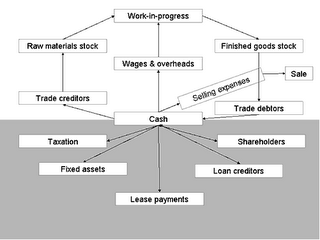
Another way of looking at these is the number of days the working capital cycle takes. It can be approximated by converting these component ratios into number of days by dividing 365 by these ratios. In BPCL’s case, it had actually declined from net 32 days to 39 days. The 7 days seemed to be on the inventory side. However, this was no cause for much concern.
The party did not last as long as I expected. The pooper turned out to be crude oil prices. The trouble with dealing in a commodity like petroleum products is that its demand is inelastic. In layman’s terms, it means that people don’t buy less of petrol (gasoline), diesel etc., just because the prices went up by a few cents; at least over a short-term. Over a longer period of time, the car companies may market more fuel-efficient cars aggressively and technological innovations like the hybrid/electric cars may pop-up. But it takes a long time for all these to happen. And, when this happens, the beneficiary definitely wouldn’t be a non-integrated refiner who buys crude from another business and sells at soft-regulated prices.
I started buying BPCL in April 01 and kept on buying all the way till 2002. My average price was around Rs.200 per share, which gave me a good margin of safety from the EV of around Rs.250 or more. For some time, my thesis seemed to have worked out pretty well. The shares traded at a high of 520 by Jan and remained thereabouts till April 04. After that, the bottom seemed to drop out and the shares went all the way to 330 levels and seemed to stage a small rally through Jan 05 and back down again at 360 levels by the end of April 05. I sold some of the shares by the end of November 04 at around 394. It started another climb from the 340 levels and I sold most of the rest around 365. By the time I exited most of the position in Aug. ’05, I had made an IRR of 21% including dividends with an NPV of 4614 at the 12% required rate. Phew!!! What a roller-coaster ride.
BPCL was a de-regulation play. The government had dismantled the APM mechanism through which subsidies were distributed to oil companies to keep the petroleum product prices down. I had friends who audited one of the local refineries and had heard war stories about the mechanism. Now, the companies were free to set their own prices; or so, it seemed.
Based on the 2000 financials, the book value of BPCL was at Rs.232.98 per share. However, that was of not much use to me since they had done a 1:1 bonus issue (stock dividend) during the year. By a reasonable estimate, the book value would have been around 130 considering the growth during the year. However, the enterprise value (EV) of the company seemed to be around 250 per share, which was what I was hoping, would come to my rescue. The relevance of EV is that BPCL would not have had to face competition from other MNC oil companies when they entered, since it would have been easier for them to buy BPCL at 233 or less per share and use the control to capture the Indian market. If they decided to build a new refinery and establish the same infrastructure that BPCL already had, it would take time as well as more money to compete. Inflation was working for me for a change. The other factor was the EV/PBIDT ratio looked pretty good at 3.4 times for 2000, which means that a deep pocket buyer could buy all of the shares of BPCL from the market and pay down all of the debt in the balance sheet and come-up with about 20% return on the total equity. (20% is approximated by inverting 3.4 and adding for tax protection of debt, since interest is tax deductible and profits are not).
Initially the new system of market pricing seemed to work. In FY 2003, BPCL posted a decent year with a 47% growth in EPS. Return on Total Assets (ROTA) went up by 42% that year from around 11% to 15%. Operating efficiency seemed to have caused the growth in EPS.
There are two components of efficiency for most manufacturing companies – operating and production efficiency. The Operating efficiency is measurable as a ration of EBIT to Value Add (Value add is calculated by deducting the material cost from sales. As the term implies, this represents the value added by the operations of the company). For oil companies, this component is called marketing margins, since this represents a higher price realization for them. This is the component of the price charged for making the by-products of crude available at the pump. There is also the component of Production efficiency (called Refining Margins for oil companies) which can be calculated as the ratio of Value Add to Sales. This is the component of the price charged for converting the raw crude to its various by-products.
BPCL seemed to have improved its marketing margins that year to compensate for a slight decrease in the refining margins. However, something that puzzled me was the increase in the inventory turnover. It had gone down by about 19% from 14 to 11.
For a manufacturing-cum-retail operation, there are two key factors/cycles that determine its ability to generate cash. One is the manufacturing cycle, which is a function of the throughput time, wherein raw material is converted to finished product. Second, shared with any product/sales operation, is the working capital cycle wherein cash is used to buy materials which are sold to customers to become receivables and later converted back to cash. These two critical cycles determine the cash generating ability of any operation.
As an aside, the beauty of the software companies that work on a turn-key or T&M basis is that they don’t have the first cycle and they have a short second cycle with a higher margin.
The efficiency of the cash generation is dependant on two factors – one is the margin in the cycle and second is the speed of the cycle. When I was a kid, I remember seeing the manually pedaled irrigation wheel looking something like this .
 It would have a big wheel with buckets at even intervals. It worked like a smaller version of the ferris wheel. It was pedal operated or animal operated and the buckets would fetch water from a lower level to the fields. I saw these two cycles the same way. The margins represent the depth of the buckets. A smart farmer could figure out that the quantity of water he would irrigate would depend on the size of the bucket and the speed of the wheel. The cycles in the product business are similar – the faster turn and higher margins assure more cash generation.
For BPCL, the buckets had deepened. However, the pace of rotation had gone slower in one area. The pace is measured by the asset turnover ratio which is Turnover divided by total assets. This can be further broken down into: Fixed Asset Turnover, Inventory Turnover, Receivables Turnover and Cash Turnover ratios. These are ratios of sales to fixed assets, inventory, receivables and cash respectively. The component turnover ratios are a way of looking at the pace at different stages of the cycle. For BPCL, there was a slow-down in the inventory side (which meant that inventory was higher in relation to sales) and a growth in the receivables side (meant faster collection). The higher receivables turnover more than offset the slow-down due to inventory accumulation. The asset turnover was higher by 19%. This is typical when you have a year of high growth.
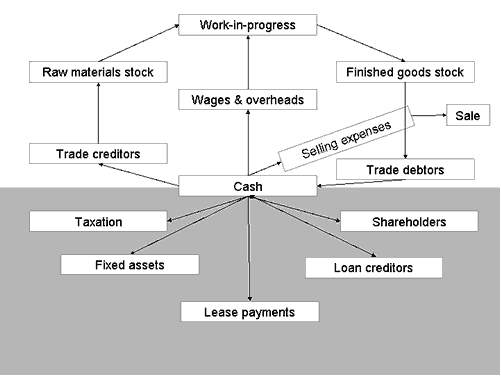
Another way of looking at these is the number of days the working capital cycle takes. It can be approximated by converting these component ratios into number of days by dividing 365 by these ratios. In BPCL’s case, it had actually declined from net 32 days to 39 days. The 7 days seemed to be on the inventory side. However, this was no cause for much concern.
The party did not last as long as I expected. The pooper turned out to be crude oil prices. The trouble with dealing in a commodity like petroleum products is that its demand is inelastic. In layman’s terms, it means that people don’t buy less of petrol (gasoline), diesel etc., just because the prices went up by a few cents; at least over a short-term. Over a longer period of time, the car companies may market more fuel-efficient cars aggressively and technological innovations like the hybrid/electric cars may pop-up. But it takes a long time for all these to happen. And, when this happens, the beneficiary definitely wouldn’t be a non-integrated refiner who buys crude from another business and sells at soft-regulated prices.
I started buying BPCL in April 01 and kept on buying all the way till 2002. My average price was around Rs.200 per share, which gave me a good margin of safety from the EV of around Rs.250 or more. For some time, my thesis seemed to have worked out pretty well. The shares traded at a high of 520 by Jan and remained thereabouts till April 04. After that, the bottom seemed to drop out and the shares went all the way to 330 levels and seemed to stage a small rally through Jan 05 and back down again at 360 levels by the end of April 05. I sold some of the shares by the end of November 04 at around 394. It started another climb from the 340 levels and I sold most of the rest around 365. By the time I exited most of the position in Aug. ’05, I had made an IRR of 21% including dividends with an NPV of 4614 at the 12% required rate. Phew!!! What a roller-coaster ride.
Divergent Paths - 1
The next two scrips I bought couldn’t have taken a more divergent path. One was a good cautionary lesson in investing in government companies. Though I didn’t lose the capital, the opportunity cost was heavy.
Subscribe to:
Posts (Atom)


 Posts
Posts